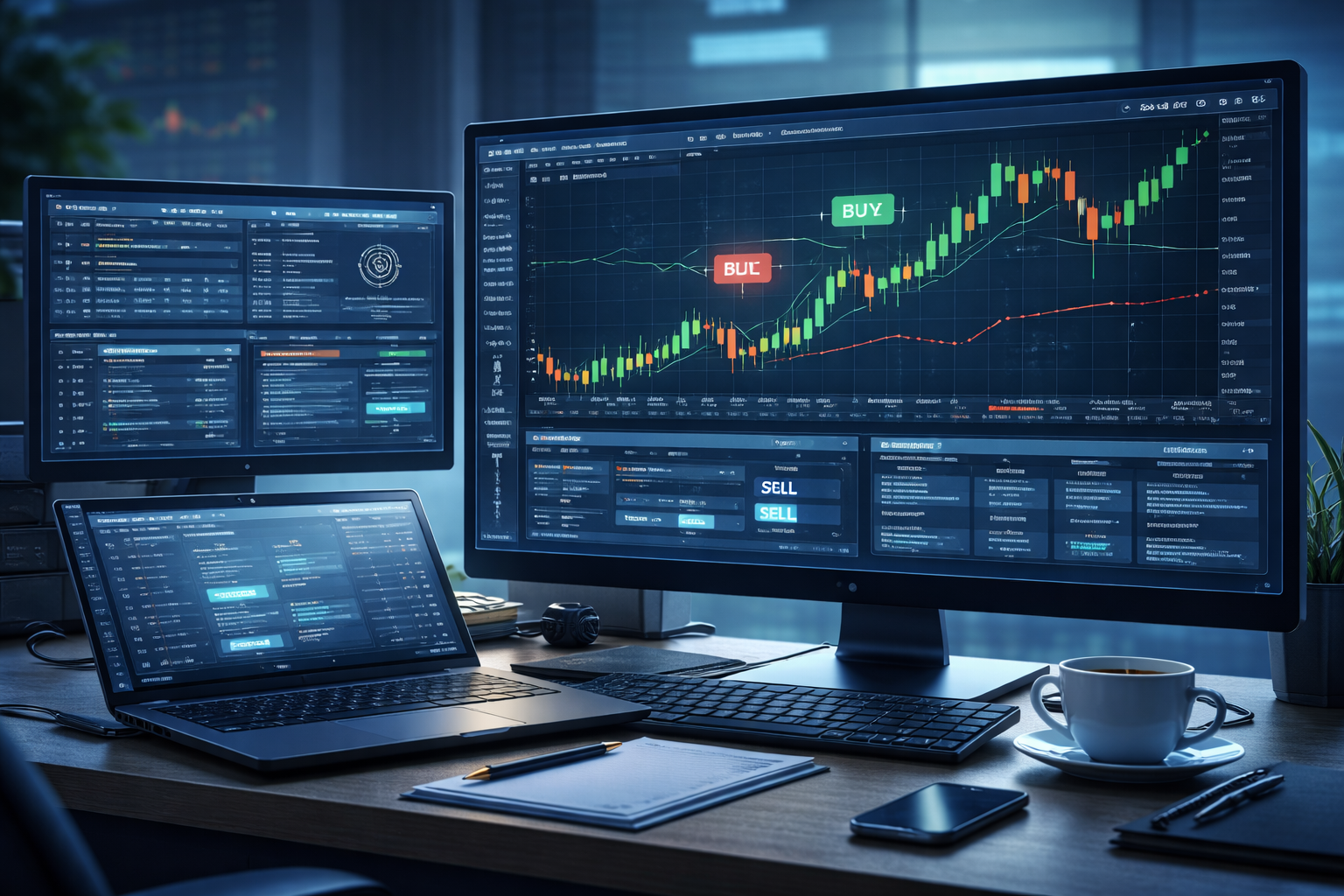
In today’s fast-moving financial markets, algorithmic trading software and automated trading systems are widely discussed among active traders. These technology-driven tools help execute buy and sell orders based on predefined rules, supporting faster and more consistent trade execution compared to fully manual workflows.
This guide explains the fundamentals of algorithmic trading, how automated systems operate within MetaTrader 5 (MT5) environments, and what traders should realistically expect before using automation tools.
What Is Algorithmic Trading Software?
Algorithmic trading software is a program that executes trades based on rules defined by the user. These rules may incorporate price levels, technical indicators, timing conditions, or risk parameters. Once configured, the software monitors market data and triggers orders when the specified conditions are met.
Rather than replacing trader judgment, the software functions as an execution layer that follows predefined instructions. Mindstocs provides automation infrastructure designed to support rule-based strategy deployment within MT5 environments.
What Is an Automated Trading System?
An automated trading system (ATS) is the practical implementation of algorithmic trading logic. It continuously scans the market and executes trades according to the parameters configured by the user.
In most trading workflows, the trader designs or selects the strategy logic, while the automation software handles monitoring and order execution. These systems are commonly used to improve execution discipline and reduce manual intervention.
Mindstocs provides software tools only and does not generate trading signals, manage client funds, or provide investment advice.
Has SEBI Banned Algo Trading?
No. Algorithmic trading has not been banned in India. Regulatory authorities such as the Securities and Exchange Board of India (SEBI) have introduced guidelines to ensure that algorithmic trading is conducted responsibly and through authorized channels.
The regulatory focus is primarily on investor protection, transparency, and preventing misleading performance claims. Traders are responsible for ensuring their broker and trading activities comply with applicable SEBI and exchange requirements.
Is Algorithmic Trading Guaranteed to Be Profitable?
No trading approach—manual or automated—can guarantee profits. Financial markets are influenced by volatility, liquidity changes, macroeconomic events, and many other unpredictable factors.
Algorithmic trading software may help traders:
- execute rules consistently
- reduce emotional decision-making
- standardize risk controls
However, performance always depends on strategy quality, market conditions, and user-defined risk management.
Mindstocs emphasizes execution technology and does not make profit guarantees.
Which Algorithms Are Commonly Used in Trading?
There is no single “best” algorithm for trading. Different strategies perform differently depending on market conditions. Common categories include trend-following models, mean-reversion strategies, statistical arbitrage approaches, and other rule-based systems.
The suitability of any algorithm depends on the trader’s objectives, testing results, and risk tolerance. Most experienced traders validate their models through backtesting and forward testing before live deployment.
Is an Automated Trading System Profitable?
An automated trading system can be profitable under certain conditions, but results are never assured. Automation primarily improves execution efficiency and consistency; it does not ensure positive outcomes.
Professional traders typically evaluate:
- strategy robustness
- drawdown behavior
- risk-adjusted performance
- stability across market regimes
Even well-designed systems can experience losses during unfavorable market conditions.
What Is the 2% Rule in Trading?
The 2% rule is a commonly used risk management guideline. It suggests that a trader should avoid risking more than 2% of total trading capital on a single position.
For example, if a trading account has $10,000 in capital, the maximum risk per trade would typically be limited to $200. This approach helps preserve capital during losing periods and supports long-term survivability.
Many systematic traders incorporate position sizing rules similar to the 2% principle within their automation logic.
Algorithmic Trading vs Manual Trading
Algorithmic trading focuses on rule-based execution and consistency, while manual trading relies on real-time human decision-making. Automation can help reduce execution delays and emotional interference, but manual oversight and strategy evaluation remain important.
Many traders begin with discretionary trading and gradually incorporate automation after developing and testing a structured strategy.
Tips for Traders Exploring Automation
Traders considering algorithmic or automated trading typically benefit from:
- understanding core market mechanics
- thoroughly backtesting strategies
- starting with controlled risk levels
- monitoring live performance carefully
- continuously refining their models
Automation works best when combined with disciplined risk management and realistic expectations.
Conclusion
Algorithmic trading software and automated trading systems have become important tools in modern trading workflows. When used responsibly, MT5 automation can support more consistent and disciplined execution.
However, automation is not a substitute for strategy development, testing, and risk control. Market risk remains present in all forms of trading.
Mindstocs provides automation software designed to help traders implement rule-based workflows within MetaTrader 5. The platform does not provide investment advice, brokerage services, or guaranteed outcomes. Users remain fully responsible for their trading decisions and risk management.
Risk Disclosure: Trading in financial markets involves substantial risk. Mindstocs provides automation software only and does not offer investment advice, brokerage services, or trading signals. Users are solely responsible for their trading decisions and risk management.